
Emergency AC Repair Guide: Steps to Take Before Calling
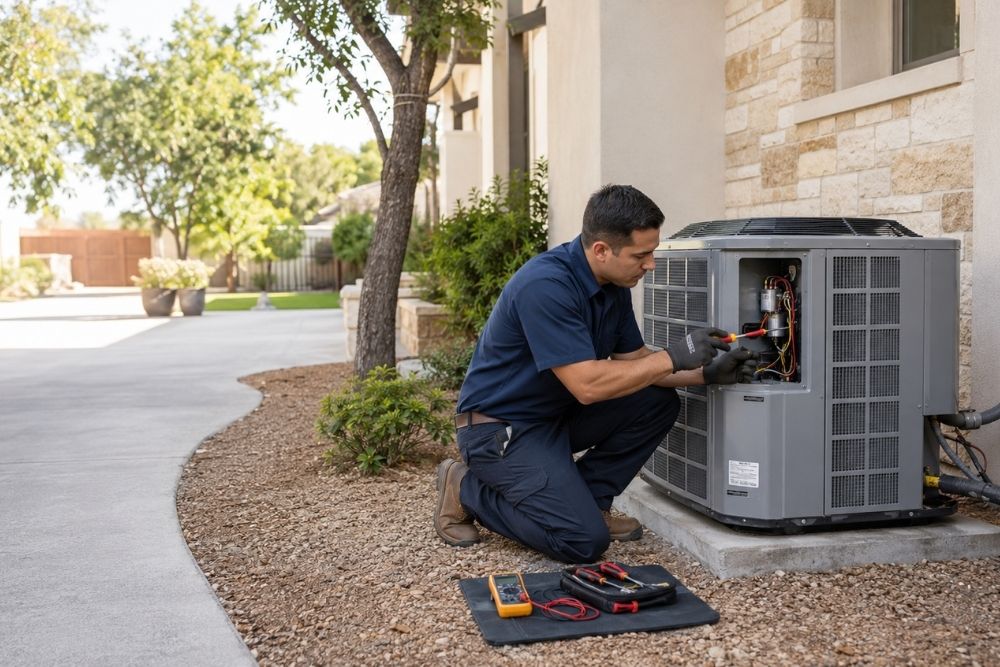
When an AC stops cooling during a San Antonio summer, indoor temperatures can rise quickly. Before calling for emergency AC repair in San Antonio, a few safe checks may help you identify a simple issue and provide useful information to the technician.
Limit your inspection to controls and areas designed for normal homeowner access. Do not open equipment panels, touch wiring, handle refrigerant lines, or attempt internal repairs.
1. Check the thermostat
Confirm that the thermostat is:
- Set to Cool
- Set below the current room temperature
- Showing the correct date and time
- Powered and displaying normally
- Using working batteries, if required
Wait a few minutes after changing the setting. Some systems have a built-in delay that prevents them from restarting immediately.
If the display is blank, replace the batteries when applicable. A blank thermostat can also be related to an electrical, drain-safety, or equipment issue that requires professional diagnosis.
2. Inspect the air filter
A heavily clogged filter can restrict airflow and affect cooling performance. Locate the filter and check whether it is covered with dust or debris.
If it is dirty, replace it with the correct size and install it in the airflow direction indicated by the arrow on the filter frame.
If the system is still not cooling after the filter is replaced, schedule an AC repair evaluation. The U.S. Department of Energy recommends professional service when an air conditioner needs more than routine maintenance or does not cool adequately. Review the DOE’s air-conditioner maintenance guidance.
3. Check the electrical breaker safely
Look at the labeled breaker for the indoor or outdoor AC equipment only if you can access the electrical panel safely.
If a breaker has tripped, it may be reset once. If it trips again, stop resetting it and call a qualified HVAC professional. Repeated breaker trips can indicate an electrical or equipment problem.
Do not touch the electrical panel if there is water nearby, visible damage, heat, smoke, or a burning smell.
4. Look for blocked airflow
Check that indoor supply and return vents are open and not blocked by furniture, rugs, curtains, or boxes.
Outside, look for leaves, grass clippings, or vegetation crowding the condenser. Remove only loose debris that can be reached safely from around the unit. Do not remove covers or reach inside the equipment.
5. Check for water or ice
Water near the indoor unit may be related to condensation drainage, a frozen coil, or another system issue.
If you see ice on the refrigerant line or indoor equipment:
- Turn off the cooling mode
- Do not chip or scrape the ice
- Do not continue running the system
- Call for professional service
If water is approaching electrical equipment, avoid the area and seek immediate assistance.
Warning signs that need professional AC repair
Call for service when the air conditioner:
- Blows warm air
- Will not turn on
- Runs but does not cool the home
- Starts and stops repeatedly
- Trips a breaker more than once
- Leaks water indoors
- Develops visible ice
- Produces grinding, buzzing, or other unusual sounds
- Produces a burning or electrical odor
If you see smoke or suspect an active fire, leave the area and contact emergency services. Do not rely only on an HVAC service call.
What to tell the AC technician
Before calling, write down:
- When the problem started
- What the thermostat displays
- Whether the indoor fan or outdoor unit is running
- Any unusual sounds or odors
- Whether a breaker tripped
- Whether you found water or ice
- Any recent maintenance or repair work
These details can help the technician begin the diagnostic process more efficiently.
Why professional diagnosis matters
An AC problem can have several possible causes. For example, weak cooling may involve restricted airflow, electrical controls, a dirty coil, refrigerant concerns, duct leakage, or a failing component.
A qualified technician can inspect the system, take appropriate measurements, identify the source of the problem, and explain the available repair options.
Air Texas provides 24/7 AC repair in San Antonio and nearby communities. Its technicians service all major AC brands and diagnose systems that stop cooling, blow warm air, or will not turn on.
If your AC is not cooling, call Air Texas at (210) 602-7181 or schedule an appointment.